Short version: before you send a proof of address to Binance, four things have to line up — the name on the document matches the ID document you submitted, the address matches the one you typed into the form, there is an issue date that still falls inside the accepted window, and the document was issued by an organization you can identify from the page itself. Even with all four, the document type, your region’s list and validity window, and the upload rules still have to match.
When a document comes back rejected, read the reason on the upload page first. A genuine document is not automatically a valid proof of address: Binance accepts a broadband bill that meets the requirements, but lists payslips among the documents it generally does not accept.
Name, address, date, issuer — one at a time
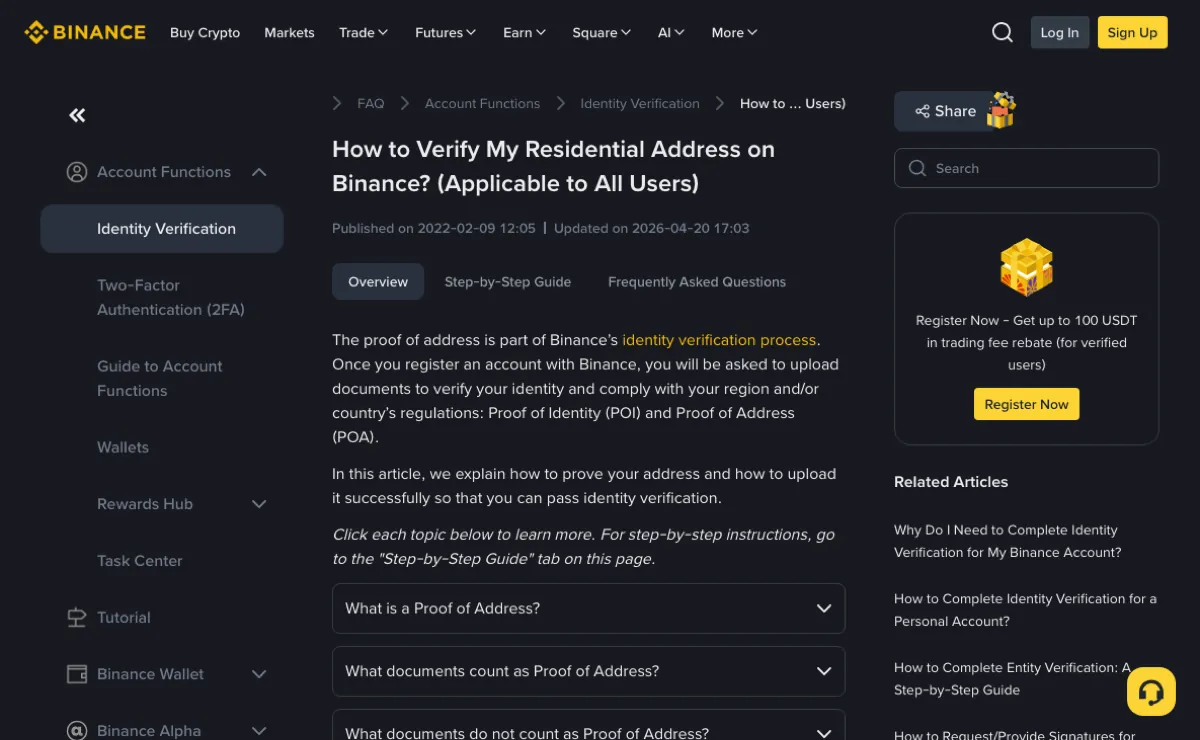
The help page is blunt about it. The document has to show your name, matching the ID document you submitted; your home address, matching the residential address you entered; the date it was issued; and the issuing authority. We checked How to Verify My Residential Address on Binance? (Applicable to All Users) in September 2026.
| Field | What review is confirming | When to look twice |
|---|---|---|
| Name | The document was issued to you | It is addressed to a parent, a partner or a company |
| Address | It points at the address you entered | The unit number is missing, or the postcode differs from the form |
| Issue date | The document is recent enough | The date line was cropped off, or it has expired |
| Issuer | A third party produced it | A summary you assembled yourself, with no visible source |
“Matching the ID document you submitted” in the first row is worth a second read. Live in a flat owned by a parent or a partner and the bill is not in your name — which means it does not meet the issued-in-your-own-name requirement, however real the bill is. Usually that sends you looking for something else in your own name: broadband, a bank, or a residence certificate from the local authority. In the address row the standard is completeness — unit or house number, street, postcode, all present.
What the platform will take
Binance’s list gives you a few places to look:
- Utilities and telecoms: electricity, water and similar utility bills, utility service contract confirmations, statements from an internet service provider, and landline, internet, TV or communications package bills. Mobile phone bills are generally not part of this group, apart from certain regions.
- Banks and financial institutions: bank or credit card statements, investment account statements, mortgage statements and bank transfer receipts, plus stamped or signed reference letters, address confirmation letters and account balance certificates.
- Government and education: official government correspondence, a residence certificate from the local authority, tenancy agreement registration certificates issued by a state body or confirmed by the housing authority, student tenancy agreements for university halls, and school letters confirming enrollment and address. Building management statements and home insurance statements or certificates are on the list too.
One that gets missed: a national ID card or permanent residence permit showing your residential address can serve as proof of address — but it cannot be the same document you used for the identity step.
My own habit is to start with a bank statement or a broadband bill, and to check the issue date before anything else. A file you downloaded this morning can cover a billing period that closed long ago; the download date is not the issue date. Utility bills behave the same way, so each one gets looked at on its own.
The ones that look close but don’t count
The generally-not-accepted list includes standalone mobile phone bills (outside certain jurisdictions), payslips and employment contracts, store-issued credit card statements, transaction receipts, provisional bank statements, letters and marketing material from banks, fee schedules, loan marketing letters, invoices that don’t state which product or service was ordered, insurance documents with home insurance excepted, streaming service bills and medical bills. Mail forwarding addresses, virtual office addresses, and anything showing only a PO box without a clear residential address are out as well.
Watch the near-identical names. A bank transfer receipt sits on the accepted list; an ordinary transaction receipt sits on the other one. Home insurance is the stated exception inside the insurance category. “A bank issued it” and “it has an address on it” are not enough on their own — go down the list item by item.
A payslip carries your name and your address and is still not accepted. The help page doesn’t say why. Switching to something the accepted list names outright takes less time than arguing the point.
The date line deserves its own look
For Binance personal accounts the general window is 6 months. A named group of countries uses 3 months instead — Argentina, Australia, Brazil, Colombia, El Salvador, Italy, Mexico, New Zealand, Poland, Spain and Sweden — and India uses 2 months. Binance’s regional entities sit on their own rows in that table (Japan, Kazakhstan and France in one place, the Bahrain/GCC and Dubai entities in another), so read the row for the entity that serves you rather than the country default. Particular document types carry their own exception too: a government tenancy contract, or the registration certificate for one, is listed as valid within 1 year, while a certificate of residence from local government follows the 3- or 6-month window of the jurisdiction. So don’t default to 6 months. Check which region applies to you, then which category the document in your hand falls into.
Expiry is only half of it. The other half is whether the issue date can be read at all. Export a PDF that captured only the amount block, or photograph a page with the header cut off, and the date and the issuer’s name are usually on exactly the line that went missing.
The file itself: format, complete, unedited
Accepted formats are PDF, JPG, JPEG and PNG, and PDF is the one the page recommends. Screenshots and colour scans are accepted as well, provided the first page is clearly visible, all data inside is legible and your personal details are distinguishable. Whatever you send has to be original and unedited — avoid cropped files, and photocopies are not accepted.
Where “unedited” stops is where a lot of people get stuck. Can you black out a card number? Can you add a “for verification only” watermark? That question sits between privacy and the upload rules, and we wrote it up on its own in can you watermark a KYC document, so it isn’t repeated here.
The page frames it as either a photo or scan of a hard-copy bill, or the PDF of a paperless one. When a banking app can export the original PDF, I open it first and confirm the name, address, date and issuer are all inside — which also saves you the reflections you get photographing a screen.
The address on the form against the address on the document
Both can look correct and still disagree. The document abbreviates and you wrote it out in full. The document carries a unit number you left out. The postcode you typed belongs to the street next door. Review is comparing whether the two point at the same place, not which of them is better written.
Open the document first, then fill in the residential address. On Binance web the stated path is Profile → Account → Identification → Get Verified Plus; after reading the notes you enter your current address and its details, choose the document type, then upload the file and confirm the name and address. If your account doesn’t show that entry point, follow the prompts on the page or ask official support — and don’t click through from a link in an unexpected email.
After a rejection, in what order to try again
Binance says proof of address may take 1 to 2 business days to review and that you’ll be notified automatically. That is an estimate rather than a fixed schedule; there’s no need to chase support while the clock runs. If yours has already come back, open the upload page and read the reason given. If the message doesn’t make sense, or it keeps failing, that’s the point to take it to official support.
Then work through it in this order. Is it addressed to you. Is the address complete, and does it point at the same place as the form. Is the issue date still inside the window. Is the whole page there, uncropped. If all four are clean and it still fails, change document category — a bank statement instead of a utility bill — rather than resubmitting the identical file.
Identity verification also has an ID document stage and a liveness stage. If you’re stuck somewhere other than address, what to check when Binance KYC fails breaks the process down stage by stage.
What this page can’t check for you
Requirements differ by location, and both the accepted list and the validity windows get revised. Whatever your account’s upload page shows right now is the version that counts. This site does not access accounts, does not handle verification for anyone, and does not collect ID documents, addresses or any other personal details. If a document keeps being rejected, or you disagree with the outcome, that goes through the platform’s official support channel.